intellectual property rights: This blogger firmly believes in intellectual and other property rights. Links have been given to the material including images and maps used from outside sources. The blogger requests pointing out any material that have escaped this policy.
Today: consumption kills eco-systems; fraud, greed, grand larceny and theft bring down world's finances; deceit, infidelity and instant gratification destroy families; murders and wars have left us without peace or stability. On top we have droughts, earthquakes, floods, storms, tsunamis … has the world gone mad! Submit now to Allah before it is too late - to the One and Only God, the Creator, Lord and Sustainer of the universe, Unique in His Person and Actions, without any blemish, weakness or relatives. Follow the Sunnah of Muhammad (the last Messenger and Prophet - upon whom be the peace and blessings of Allah), and join those who will be the really successful ones.

see end of page for buttoned useful links

Wednesday, February 10, 2010

Dr Aafia's case

If anyone ever thought the US system of justice delivers justice, this case should open his/ her eyes.

http://www.thenews.com.pk/daily_detail.asp?id=223448

The truth about US justice
Wednesday, February 10, 2010
By Yvonne Ridley


Many of us are still in a state of shock over the guilty verdict returned on Dr Aafia Siddiqui. The response from the people of Pakistan was predictable and overwhelming and I salute their spontaneous actions.


The truth about US justice


The Powerful Testimony of Dr. Aafia Siddiqui

THE POWERFUL TESTIMONY OF Dr. Aafia Siddiqui


As captured by El-Hajj Mauri’ Saalakhan


Aafia Siddiqui – a daughter, a sister, a mother of three, committed Muslim, social scientist, hafiz of Qur’an – needed to be heard. For years she had suffered in virtual silence…aching to be heard, to be understood, to have certain malicious untruths corrected and exposed for the lies they were.

Wednesday, January 13, 2010

CIA and Xe Corporation (Blackwater)!

WILL THE REAL CIA PLEASE STAND UP?

By Gordon Duff STAFF WRITER/Senior Editor

Were the seven CIA employees killed in the recent terror attack at Camp Chapman in Afghanistan really CIA? Sources now tell us that some were Blackwater operatives, not CIA at all.

Is the CIA and Blackwater one in the same? Are either one or both working for the United States or has the disease of privatization created a culture of greed and incompetence that has left the United States vulnerable and defenseless? Are we simply "out of our depth" in Afghanistan?


Wednesday, January 06, 2010

Banned by confused Muslimah

I have just been banned from jannah.org forum

Of late the sweet young lady running that forum has been turning into an apologist for US special status claims.

Well, she is welcome to this freedom. However, such freedom is not available to dissenters on her forum, not any more.

I don't grudge her this banning. Life in non-Muslim countries is harsh for Muslims, with the media and society and agencies all ballistic about the Islamic threat (!). Muslims engaged in Dawah work cannot tolerate the view that non-Muslim militaries and intelligence agencies are fair targets. It makes them susceptible to charges of unpatriotic and subversive attitudes.

Good luck to jannah and her efforts to survive in the jungle that is the United States of America.

Now about the confused part:

This is not about ABCD or BBCD - American Born or British Born Confused Desis. Those are outdated terms.

This is about those Muslims who confuse Jihad with Terrorism.

Sunday, January 11, 2009

The Gaza massacres and offshore gas fields


War and Natural Gas: The Israeli Invasion and Gaza's Offshore Gas Fields
News Watch
Sunday, 11 January 2009

Update: in response to the request for maps mentioned in the first comment, the post has now been modified to include the maps:


The military invasion of the Gaza Strip by Israeli Forces bears a direct relation to the control and ownership of strategic offshore gas reserves.

This is a war of conquest. Discovered in 2000, there are extensive gas reserves off the Gaza coastline. British Gas (BG Group) and its partner, the Athens based Consolidated Contractors International Company (CCC) owned by Lebanon's Sabbagh and Koury families, were granted oil and gas exploration rights in a 25 year agreement signed in November 1999 with the Palestinian Authority.

The rights to the offshore gas field are respectively British Gas (60 percent); Consolidated Contractors (CCC) (30 percent); and the Investment Fund of the Palestinian Authority (10 percent). (Haaretz, October 21, 2007).

The PA-BG-CCC agreement includes field development and the construction of a gas pipeline.(Middle East Economic Digest, Jan 5, 2001).

The BG licence covers the entire Gazan offshore marine area, which is contiguous to several Israeli offshore gas facilities. (See Map below). It should be noted that 60 percent of the gas reserves along the Gaza-Israel coastline belong to Palestine.

The BG Group drilled two wells in 2000: Gaza Marine-1 and Gaza Marine-2. Reserves are estimated by British Gas to be of the order of 1.4 trillion cubic feet, valued at approximately 4 billion dollars. These are the figures made public by British Gas. The size of Palestine's gas reserves could be much larger.

Who Owns the Gas Fields

The issue of sovereignty over Gaza's gas fields is crucial. From a legal standpoint, the gas reserves belong to Palestine.

The death of Yasser Arafat, the election of the Hamas government and the ruin of the Palestinian Authority have enabled Israel to establish de facto control over Gaza's offshore gas reserves.

British Gas (BG Group) has been dealing with the Tel Aviv government. In turn, the Hamas government has been bypassed in regards to exploration and development rights over the gas fields.

The election of Prime Minister Ariel Sharon in 2001 was a major turning point. Palestine's sovereignty over the offshore gas fields was challenged in the Israeli Supreme Court. Sharon stated unequivocally that "Israel would never buy gas from Palestine" intimating that Gaza's offshore gas reserves belong to Israel.

In 2003, Ariel Sharon, vetoed an initial deal, which would allow British Gas to supply Israel with natural gas from Gaza's offshore wells. (The Independent, August 19, 2003)

The election victory of Hamas in 2006 was conducive to the demise of the Palestinian Authority, which became confined to the West Bank, under the proxy regime of Mahmoud Abbas.

In 2006, British Gas "was close to signing a deal to pump the gas to Egypt." (Times, May, 23, 2007). According to reports, British Prime Minister Tony Blair intervened on behalf of Israel with a view to shunting the agreement with Egypt.

The following year, in May 2007, the Israeli Cabinet approved a proposal by Prime Minister Ehud Olmert "to buy gas from the Palestinian Authority." The proposed contract was for $4 billion, with profits of the order of $2 billion of which one billion was to go the Palestinians.

Tel Aviv, however, had no intention on sharing the revenues with Palestine. An Israeli team of negotiators was set up by the Israeli Cabinet to thrash out a deal with the BG Group, bypassing both the Hamas government and the Palestinian Authority:

"Israeli defence authorities want the Palestinians to be paid in goods and services and insist that no money go to the Hamas-controlled Government." (Ibid, emphasis added)

The objective was essentially to nullify the contract signed in 1999 between the BG Group and the Palestinian Authority under Yasser Arafat.

Under the proposed 2007 agreement with BG, Palestinian gas from Gaza's offshore wells was to be channeled by an undersea pipeline to the Israeli seaport of Ashkelon, thereby transferring control over the sale of the natural gas to Israel.

The deal fell through. The negotiations were suspended:

"Mossad Chief Meir Dagan opposed the transaction on security grounds, that the proceeds would fund terror". (Member of Knesset Gilad Erdan, Address to the Knesset on "The Intention of Deputy Prime Minister Ehud Olmert to Purchase Gas from the Palestinians When Payment Will Serve Hamas," March 1, 2006, quoted in Lt. Gen. (ret.) Moshe Yaalon, Does the Prospective Purchase of British Gas from Gaza's Coastal Waters Threaten Israel's National Security? Jerusalem Center for Public Affairs, October 2007)

Israel's intent was to foreclose the possibility that royalties be paid to the Palestinians. In December 2007, The BG Group withdrew from the negotiations with Israel and in January 2008 they closed their office in Israel.(BG website).

Invasion Plan on The Drawing Board

The invasion plan of the Gaza Strip under "Operation Cast Lead" was set in motion in June 2008, according to Israeli military sources:

"Sources in the defense establishment said Defense Minister Ehud Barak instructed the Israel Defense Forces to prepare for the operation over six months ago [June or before June] , even as Israel was beginning to negotiate a ceasefire agreement with Hamas."(Barak Ravid, Operation "Cast Lead": Israeli Air Force strike followed months of planning, Haaretz, December 27, 2008)

That very same month, the Israeli authorities contacted British Gas, with a view to resuming crucial negotiations pertaining to the purchase of Gaza's natural gas:

"Both Ministry of Finance director general Yarom Ariav and Ministry of National Infrastructures director general Hezi Kugler agreed to inform BG of Israel's wish to renew the talks.

The sources added that BG has not yet officially responded to Israel's request, but that company executives would probably come to Israel in a few weeks to hold talks with government officials." (Globes online- Israel's Business Arena, June 23, 2008)

The decision to speed up negotiations with British Gas (BG Group) coincided, chronologically, with the planning of the invasion of Gaza initiated in June. It would appear that Israel was anxious to reach an agreement with the BG Group prior to the invasion, which was already in an advanced planning stage.

Moreover, these negotiations with British Gas were conducted by the Ehud Olmert government with the knowledge that a military invasion was on the drawing board. In all likelihood, a new "post war" political-territorial arrangement for the Gaza strip was also being contemplated by the Israeli government.

In fact, negotiations between British Gas and Israeli officials were ongoing in October 2008, 2-3 months prior to the commencement of the bombings on December 27th.

In November 2008, the Israeli Ministry of Finance and the Ministry of National Infrastructures instructed Israel Electric Corporation (IEC) to enter into negotiations with British Gas, on the purchase of natural gas from the BG's offshore concession in Gaza. (Globes, November 13, 2008)

"Ministry of Finance director general Yarom Ariav and Ministry of National Infrastructures director general Hezi Kugler wrote to IEC CEO Amos Lasker recently, informing him of the government's decision to allow negotiations to go forward, in line with the framework proposal it approved earlier this year.

The IEC board, headed by chairman Moti Friedman, approved the principles of the framework proposal a few weeks ago. The talks with BG Group will begin once the board approves the exemption from a tender." (Globes Nov. 13, 2008)

Gaza and Energy Geopolitics

The military occupation of Gaza is intent upon transferring the sovereignty of the gas fields to Israel in violation of international law.

What can we expect in the wake of the invasion?

What is the intent of Israel with regard to Palestine's Natural Gas reserves?

A new territorial arrangement, with the stationing of Israeli and/or "peacekeeping" troops?

The militarization of the entire Gaza coastline, which is strategic for Israel?

The outright confiscation of Palestinian gas fields and the unilateral declaration of Israeli sovereignty over Gaza's maritime areas?

If this were to occur, the Gaza gas fields would be integrated into Israel's offshore installations, which are contiguous to those of the Gaza Strip. (See Map 1 above).

These various offshore installations are also linked up to Israel's energy transport corridor, extending from the port of Eilat, which is an oil pipeline terminal, on the Red Sea to the seaport - pipeline terminal at Ashkelon, and northwards to Haifa, and eventually linking up through a proposed Israeli-Turkish pipeline with the Turkish port of Ceyhan.

Ceyhan is the terminal of the Baku, Tblisi Ceyhan Trans Caspian pipeline. "What is envisaged is to link the BTC pipeline to the Trans-Israel Eilat-Ashkelon pipeline, also known as Israel's Tipline." (See Michel Chossudovsky, The War on Lebanon and the Battle for Oil, Global Research, July 23, 2006)

What if the FBI or DHS wants to question you

What To Do If The FBI or Department of Homeland Security Wants to Question You

Source: ACLU Immigrants' Rights Project

The FBI and other law enforcement agencies are increasing their attempts to question and monitor many people over the next few weeks and months. Keep the following tips in mind if this affects you.

get_involved/got_rights.html

When law enforcement officers ask you to answer questions:

• If you are approached in person by an officer, ask if you are "free to leave." If you are, consider walking away. If officers come to your home, you do not have to answer the door or let them in unless they have a warrant from a court authorizing them to search your home. You can ask them to leave a business card under the door and tell them you will call them if you decide to talk to them.

• Ask if the interview is "voluntary." If you are told that it is your decision whether to be interviewed, consider saying "no."

• You have the right to remain silent and not answer questions, even if you are not free to leave.

In some states, you must give your name if an officer asks for it, but you do not have to say anything else. If you are a "nonimmigrant" (you are not a “nonimmigrant” if you are undocumented, out of status, a legal permanent resident (green card holder), or a citizen), you may be required to provide information related to your immigration status, but you can do so through a lawyer. Ask for the officer’s business card, and tell the officers your lawyer will call when you are ready to speak with them.

• Consult a lawyer before agreeing to answer any questions. The law is complicated – you can have a problem even though you don’t know it.

Officers may pressure you to answer questions before you can talk to a lawyer. For example, officers may suggest that talking to a lawyer makes it look like you have something to hide. If you want to talk to a lawyer, do not let the officers stop you.

There are many reasons why you might want to consult a lawyer. A lawyer can protect your rights.

If you need free legal advice about an interview, call your local American Civil Liberties Union (ACLU), American-Arab Anti-Discrimination Committee (ADC) at 202.244.2990, Council on American-Islamic Relations (CAIR) at 202.646.6034, or Muslim Public Affairs Council (MPAC) at 800.898.3558.

• If you agree to be interviewed, you can set the day, time and place for the interview. Tell the officers if you need an interpreter. Do not answer questions if you need an interpreter and a free interpreter is not provided.

If you agree to be interviewed:

• Have a lawyer present the entire time you are questioned. If you do not have a lawyer, consider having someone you trust (someone who is a citizen or has valid immigration status) be a witness to the interview or tell the officers that you want to tape the interview.

• If you agree to answer some questions, you can still refuse to answer other questions.

• Nothing is "off the record" when you talk to an officer. Everything you say will be recorded in some way, and anything you say can be used against you.

• Lying to a federal officer is a crime, but remember that you can refuse to answer any question.

• Lying on an application for an immigration benefit can also get you in trouble with the law.

• Laws that deal with charitable contributions can be complicated. If you are asked about your charitable contributions, strongly consider not answering those questions.

• If you are asked to sign anything, including a statement summarizing your interview, do not sign it unless you have carefully read it, you understand everything it says, and you agree to everything it says. It is always best to have a lawyer review documents before you sign them. Be careful about signing away your rights.

10.15.04 This notice is not a substitute for legal advice.

PDF Link: FBIHomelandQuestions.pdf
Print and post in your masjid and on your fridge!


PDFs in URDU, ARABIC, SPANISH, SOMALI, PUNJABI, and HINDI.

immigrantrights

if you are free to go you don't have to answer questions. If you are not free to go you have the right to have a third party present (preferably a lawyer, or at least someone with some legal knowledge) however, unless you are under arrest then you must be free to go. If you are under arrest then your Miranda rights must be read and that entitles you the right to remain silent or have an attorney present before questionning can begin. In any instance if you opt to speak, caution is essential because anything said can be recorded (taped or written down) and used against you later.

Many people are intimidated by law enforcement officials (even in all my outward strength I'm not gonna say I wouldn't feel intimidated either). It is this fact that is often used to get people to answer questions. The alternative is law enforcement trying to causual almost friendly approach to gain trust and get a person to let their guard down and just respond to seemingly innocent questions. Again, caution is always wise. It's not to say that we should immediately be distrustful, but it is always better to err on the side of caution. One can give short, honest answers; detailed responses are not required.

There's no telling how many, in response to innocent questions during the special INS registrations that were required for all immigrants to the US from certain countries were detained and ultimately deported because they innocently gave lengthy answers. Requests for information on these counts through Freedom of Information Law (FOIL) requests were denied. The rationale of "not having such records" I believe is a crock; everything is documented.

Wednesday, December 03, 2008

Why me-ism and why not me-ism

Most people I have met have voiced this question (why me?) or a variation:

Why not me?

It seems the typical human is a saint, and is being perpetually wronged. Disaster after disaster befalls him. Merit is not rewarded. The "others" are hounding him. All he wants is something simple and achievable like … which every Tom, Dick and Harry is getting, but he is being denied his right.

○ The teacher doesn't know the subject. He gave me less marks because I am brilliant, and he is jealous.

○ I did not get the job because they received a phone call from a general/ federal secretary/chairman

○ I belong to a different ethnic background/sect, and they are very prejudiced

And so on …

So one says "Why me?" when he perceives a wrong to him, and "why not me?" when he sees someone else with something his heart desires, like a palatial house, a BMZ, glittering jewelry, well-behaved and brilliant children, etc.

Today I applied the reverse:

A young man who is one of those who has hounded me often to take money from me, came again with his tales of woes. I have decided to be a little more strict, as I too have to live within a budget, so I told him off, and came back inside.

Then I asked: "Why not me?" I mean, why aren't I the one going begging. It made me feel so grateful to Allah that I had been spared this fate. Then I recollected many more such people. Orphans who live in orphanages, and at one time were sent out to beg for themselves and the orphanage.

Why not me? I mean wasn't it a tremendous blessing that I lived with my family who catered for all my problems, and when I left, I still get looked after, and also receive duas, totally undeserved duas at that.

Some years ago, when my sister was buying a house in Karachi, I was there, so I was asked to check it make suggestions for alteration. As I was going into the house, a man, about my age, was pushing a vegetable cart. He was a vegetable seller. He said:

"Seth, Allah has given you so much. I am your age, but I cannot even arrange a place to sell my vegetables. If I could afford a small shop, I would not have to push this cart".

Now, I could have answered with the truth: that I am not a seth; I am a worker. Neither me, nor my sister can afford to set up a shop for you. But I stopped short; gave him some money, and went about my business.

Why wasn't it me who was pushing that cart?

Something to ponder about.

So next time you feel like "Why me?", ask yourself: "Why not me?".

And if you feel like: "Why not me?", Then ask: "Why me?"

Friday, October 17, 2008

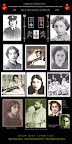
Noor's photos


From a sane voice in a mad world


Noor Inayat Khan: courage & self-sacrifice

I wrote this on Eid night.

October 1st, 2008 Chaand Raat of Eid-ul-Fitr.

I won't be writing about Eid day. It will be tonight- Chand Raat, Eid night.

It is Eid night here, and I cannot sleep …

My son is coming on Eid day in the evening, and I will be glad to see him and the bahu (d-i-L), but that is not the reason for loss of sleep.

Previously I lost sleep when I saw on TV, the US bombing of a civilian shelter in Baghdad with one of its smart missiles. What the rescue workers took out were charred bodies of women and children.

This continues to be the US mode of operation in Afghanistan and Pakistan as well.

The videos of the Bosnian and Kashmiri suffering also caused me insomnia.

Have you read Spy Princess by Shrabani Basu?

On Monday 29th September, I leafed through this interesting book at a bookstore. Initially I did not want to buy the book because of its price, but the story is so captivating, that I bought it.

I am glad that I did, for it dispelled some of the misconceptions I had developed on the leafing through.

I sat down to write a gist of the book with some comments of my own, but I cannot leave much out, and I feel very, very depressed as I go through this story.

Shrabani's narration is the most accurate so far, as it is the only one that also draws on classified War Office papers that were declassified in 2003.

Nur-un-Nisa (Noor) Inayat Khan, alias Nora Baker alias Madeleine (1914-1944), was the eldest child of Pir Inayat Khan. She was the grand-daughter of Tipu Sultan's great-great grand-daughter. Tipu was the last Muslim king of Mysore, who was martyred when fighting British soldiers of the East India Company. Noor was born at Moscow on 1st Jan 1914 to her American mother Ora Ray Baker, who had met her father when he visited the United States. Ora was a distant cousin of the woman who was the founder of the Christian Science movement. She was under age, and her guardian was in favor of her marrying Inayat, so she waited until she ocame of age. Inayat had, meanwhile had came to Europe. Ora joined him, and changed her name to Sharda Amina Begum.

Noor's father, Inayat Khan had started out as a Sufi Chishti Shaykh, who had been sent to the West for spreading Islam. Discovering prejudice against Islam, he had instead formed a new Sufi Order Universal Sufism, that regarded all religions as from God. Islam teaches that, too, but it says that the other religions are now corrupted versions of the original message. Inayat preached wahadatul wujood . In special prayer sessions, extracts from texts of holy books of different religions were read). The Movement has its own Temples, just like the Bahais. Its development, infighting for control and breakup into subsidiary Orders that are still joined together, are interesting studies as well, but we will focus on Noor here.

Inayat was a successful music teacher and performer (together with his brothers) in Moscow at the time of Noor's birth. He had become friends with Leo Tolstoy's son. WW-I began on 28th July 1914, Noor's family moved to London in August of the same year, and then to Paris in 1920.

At school, the Inayat children had to bear with considerable teasing, due to not being fluent in French (they spoke English at home), and being darker colored than their peers. Noor bore all this with good humor and a smile. She learnt to keep her thoughts to herself, and yet won friends by being sweet and helpful under all that teasing.

If Inayat were a Muslim, Sufi or not, he may have taught Noor and his other children how to gain inner strength from meditation on the Almighty. The memebrs of the Sufi Movement do Dhikr, remembrance of Allah by reciting Allah's names in original Arabic.

Noor's father visited India in 1927, was shown around Nizamuddin Auliya's dargah, became seriously ill and died there, then buried in the dargah. Her mother, overcome with grief, became ill and indisposed for the rest of her life. So Noor had to take care of her younger siblings from the age of 13. She would compose poems, in English, French and Urdu (she wrote them in Roman Urdu, as she did not know the Urdu script. She made cards by hand and illustrated them delicately with flowers and drawings of animals. She loved her family. Who does not, but her devotion and love were extraordinary.

Noor had to attend school herself, and look after the household at the same time, on an allowance that can best be described as frugal.

She joined Ecole Normal de Musique for studying Music in 1931, and fell in love with a fellow Jewish student from a working class background. They became engaged to be married. This was an unfortunate choice, as he was grossly demanding and overbearing. He was rejected by her family and its circle of friends. She, nevertheless, persevered with the engagement in the hope the family would come round. Her family, however, saw that it wasn't love but her nature of wanting to help those with handicaps that was responsible for this liaison.

She had absorbed her father's thesis (actually, an old one), that all religions led to the same Almighty, and hence got close to that fellow student. She wanted to end the engagement earlier, but he threatened her with suicide if she did not marry him. So she kept the relationship alive. But the conflict within her made her ill, and eventually she saw that she had to break the engagement.

Noor studied child psychology at Sorbonne University. Later she studied languages, and became proficient in German and Spanish. However, upon graduation, she could not apply for a job as her family was Royalty, albeit on hard times. Family traditions dictated that women got married and stayed home. She couldn't take a job, period.

A very eligible young man in the same Sufi Order, had been paying her attention for marriage, but she had not considered it because she had already been engaged. He went to India on a lucrative post, and her brother convinced her that they should follow him and she should marry him. The problem was they had no money. They went to his aunt who had helped the Order in the past. She was glad of their plans but failed to realise they needed financial help, and they were too shy to mention it, so that possibility petered out.

She started writing stories for children for Le Figaro in November 1938. She was asked to write a book for children into French. She chose Buddhist tales, and her book "20 Jataka tales" was published in the summer of 1939. She was also asked to read her stories on French radio for children's programs. A career as a writer and radio broadcaster for children's programs began to develop. This also gave her a much needed independence from her uncles and other members of the family.

She had previously liked to wear Indian dresses, but as she gained this independence, she increasingly became more European in her dress and manners. Her sister even changed her name to Claire from Khairun-Nisa, in order to fit in with the society they lived in. Amina Begum did not like this, as she had adopted the Indian dress, and was never seen without her dupatta or hijab, but tolerance was the name of the game in this Sufi order, so she kept her peace.

Noor perhaps saw herself as an Internationalist. Born in Moscow to an Indian Muslim father, and an American white mother, raised in a circle of religious tolerance, fluent in English through mother tongue, French through early schooling and living most of her life in Paris, Spanish and German through language school, Urdu and Hindi (although not the script). She wrote Urdu and Hindi poetry in Roman script. She was also an anti-Imperialist.


When the Nazis occupied France, the family decided to do whatever they could to fight them. It wasn't their war, but they could not see the Nazis deport Jews to concentration camps, and sit silently.

The mother and children, except the youngest son Hidayat, moved to London on 5th June 1940. Hidayat was married and went to the South of France for spying on the Germans. Noor and Vilayat went to the War Office in London. On 14th June 1942, Noor's "The Fairy and the Hare" was broadcast on BBC Radio's "Children's "Hour."

Noor attended RAF Commission's interview on 28th August 1942. She had a British passport, as her father was Indian, and India was the jewel in the British crown. Vilayat was rejected for the RAF, but accepted in the Royal Navy after getting a maritime certificate. Noor was accepted in the WAAF. Noor, after seeing the problems faced by the recruiting clerk in spelling Vilayat (he had entered Vialayat as Vic, and without asking his religion as Church of England), told the clerk her name was Nora Baker, and religion Church of England. Hence when living as a trainee, she attended CoE services with the other girls. To all intents and purposes, she became Nora Baker from now on in her outwardly appearance and behavior. According to her father's teachings the outward practices did not matter.

She spent a few months in WAAF, before the SOE sent for her to be interviewed in November 1942. They had been looking for recruits. Someone noticed the comment "excellent French" after her name. In her interview, she said she would remain loyal to the British as long as the war was on, but then she would return to India to fight for India's Independence. This shows her political awareness, commitment and a rare maturity. Most interviewers and testers thought she would break down under torture, as her build was slight, and her comment about India indicated an excess of emotion. She also, couldn’t lie, and what use is an agent who cannot lie to the enemy.

She was very good with the wireless, so the SOE's F-section chief wanted her. He brought her to the master codesman Leo Marks for special tuition and advice. Marks thought she was too refined and loving. "Oh, Noor, what are you doing in the SOE?", he thought. He wanted her to fail the tests, so she would stay in safer Britain, rather than behind enemy lines. However, she was the best of wireless operators he had trained and tested. He, like other interviewers, found that she could not lie, and was a little careless. He gave her advice on care, which she heeded to her last. He told her to be immaculate in her filing, which she did, and also kept copies of messages she sent, as she thought she had been told to maintain these in a file, taking the literal meaning of "filing" to her heart. As for lying, try as she might, she just couldn't. Marks told her if she couldn't lie, she would jeopardize not only herself, her mission, but also the lives of all those in contact with her or known to her in France. She thought for a while and said: "what if I say nothing".

When she came back from her incomplete training, she had a smirk on her face. she told her mother she had a job with the WAAF (Women's auxiliary Air Force) that might entail her going abroad. She also mentioned that she had become engaged to someone at the War Office, but she gave no further information. She had been so unsuccessful in her romances, that she did not want to tempt fate by telling much. No one discovered who the mysterious fiancé was, and he never came forward.

Noor remained unmarried until her death.

This is not to say she did not have a love life.

In all probability, she had sex with her fiancés - the Jewish student and the unknown man at the War Office. Antelme, a British citizen of Franco-Mauritian descent, interacted with her as with others. Her colleagues are also sure she had sex with her fellow spy, France Antelme. The details of the colleagues and their statements are not given in the book "Spy Princess". The two were even reported to be planning marriage after returning to Britain.

The lady who rented her the apartment however, thought Antelme only had a paternal interest in her. This is unlikely, Antelme was in his forties, and Noor was thirty. He may have thought initially he was showing a paternal interest, Although Noor had her fiancé back in England, and Antelme already had a French girlfriend, they had been placed together in very trying circumstances. It is possible that their mutual liking and predicament may have turned into seeking solace in sex, and exploring the possibility of spending the rest of their lives together. In such times, the existence of fiancés back home is irrelevant. All the author Shriabni says lamely is something to the effect that in the presence of fiancés back home, they could not have discussed mutual marriage plans.

Did Noor say Salah: in all probability,: no.

Did she observe the dietary rules of Islam: no

The SOE was very short of wireless field personnel, so she was sent into the field before her training was complete. When finally saying goodbye to her trainer Vera Atkins, she pointed at a book on the shelf about "Extraordinary women", remarking "men like reading about extraordinary women".

She had signed the Official Secrets Act on February 1943, and she, the first woman wireless operator to be sent abroad, was dropped in France on 16/17 June, 1943.

Her group, the Physicians Group or Prosper, had already been compromised before she joined. Most of its members were arrested within ten days of her arrival back in France. She was the only free wireless operator left in her circle, and she frantically sent information (20 messages) to London while dodging the Germans. Once she was nearly caught by two German soldiers with her radio but she said it was a home cine equipment, and they believed her.

Unfortunately for them, Antelme already had a French girlfriend in the same Resistance circle as her. Naturally the jilted girlfriend resented losing Antelme's attentions to Noor, and became jealous of her.

When the group had been broken up by the Germans and most of her circle arrested, the British recalled their operators in that circle, as it was now very dangerous to operate there. Antelme went back. Noor refused. She (the only radio operator left in the field) was the only existing contact with the British, and thus the lifeline of the French Resistance groups. So she stayed and continued to relay important messages which saved more than 30 (thirty) Allied airmen's lives who had been shot down over France.

Not surprisingly, she was betrayed by Antelme's ex-girlfriend for 100,000 Francs.

If I were a spy chief, I would emphasize that my agents avoid liaisons like these, for the risk of treachery due to jealousy is very great.

Noor was arrested by the Gestapo on 13th Septemvber 1943, and interrogated over the next month at the Paris HQ of the Gestapo.

She was pretty, petite, and delicate. Her zeal for Indian freedom was misinterpreted by her interviewers as her being too emotional. They felt she was not suitable for a spying job, and would break down under torture. However, her French was excellent. Her skin coloue, not white, not blach, but café a la crème, made her look like a Creole, and that wouldn't raise any suspicions. She was also very good with the wireless, and the Chief selector was very impressed with her. She was sent as a spy.

Under torture or psychological blackmail, she did not break down, and never revealed anything. This was testified by her prison officials later at a trial. Her interrogators were equally impressed with her integrity, perseverance, tolerance and tenacity.

She made one mistake, though, and that should be thought of as perfect attachment to what she had been told, or rather what she understood she had been told. She had kept a record of all the messages she had sent. It was against the rules of espionage. This was due to unclear instructions. She was told to be immaculate in her filing. What this meant was that she should not make mistakes in filing a report, and should be on time. That she was, but she also took it literally in maintaining a complete and accurate file of all messages she had sent. She was told by a visiting fellow agent that this was dangerous, and she should destroy that notebook containing her messages. She, however, continued to act according to what she had understood from Marks, the master cryptographer for the SOE. This misunderstanding allowed the Germans to break her code, and to relay false information that resulted in the sending and capture of more agents, including Antelme and two others, one a woman, who would die with Noor. All three were among the best spies of the British.

The concerned British authorities are to be blamed, They knew that the messages lacked a confirmation signal. Furthermore they knew that the resistance ring their agents were to be dropped into, had fallen in German hands, and was being operated by them. In fact, despite this certain knowledge, Alterme volunteered to go over to France. Maybe he was missing Noor and was feeling guilty at leaving her alone in danger. As mentioned above he, too, was captured, tortured, and executed. He too, did not divulge any information under torture.

There is evidence that the British deliberately sacrificed their agents in the field to keep the Germans off the trail of more important plans, including the Normandy landings. That they did bungle up, is without any doubt, for had they paid heed to the hidden tests of genuine transmissions, they would have understood that Noor had been captured. They also sent Noor unnecessarily to meet the Gestapo agents, who got a good look at her, and thus agent Madeleine could be recognised anywhere,

Noor even managed to escape three times. The first one on the very day she was captured where she tried to escape through the window of the lavatory she had said she was allowed to take a bath in. The second was when she persuaded two male prisoners to join her in an attempt of the building she was being kept in, but was recaptured due to heightened security through removing the bars on the skylights in their rooms. They might have succeeded had British airplanes not started bombardment of the locality. After They were asked to sign a declaration that she wouldn't try to escape again. She and another prisoner refused. Both were sent to German prisons. She to Pforzheim on 13th October 1943.

Noor was singled out for special treatment, maybe because her skin color was darker. Maybe because she did not bow to Nazi pressure, and replied with dignity to abuses. She fought her captors fiercely. She was described as dangerous and kept manacled to the wall and in solitary confinement for most of her time in captivity. Both of her legs were bound together by chains, both hands similarly, and then, hands and feet tied together by another chain, so that she cannot stand up. And what is more, she wasn't even free to move with her chains. She could not go to the toilet. She could not clean or eat herself. A cleaning woman came to clean her and her cell. Imagine if one has to answer the call of nature in the semi-nude clothing she was wearing, and in the same place she was chained to, and to put up with the filth until the cleaning woman came, and one's indignation and anger is sky high. Note too, that this was a woman just thirty. She had menstrual periods, which means involuntary secretions and smelly flows from the body from days every month. She must also have been taunted on her nudity, her smelly body, her skin colour. How she endured all this degradation, is beyond imagination, but endure she did, with her head held high, and without giving the Nazis any information.

She was allowed to wear very scanty clothes, which were insufficient to protect against the cold.

When eventually she was given some exercise, it was also in isolation, and she was taken every day an the afternoon for no more than 45 minutes. She used this time to go by doing gymnastic exercises. Her soft nature can be seen in that she profusely thanked the officer who let her out for this brief respite from the chains, although he was only doing what he was told to do.

Even the scant clothes she could wear, were removed to degrade her further, and she was left naked. She found a sackcloth, with which to hide her nudity, and to come out for a walk at the appointed time. She was given one bowl of potato peel soup per day. She was severely tortured by beatings. She was abused verbally and maybe sexually. All this was to break her spirit and to keep her weak. She was beaten, stripped naked, and had to hide her body in a sack for exercise. Once the soldiers heard some other female prisoners go by her cell singing the news of Allied victories to her. They were told off, but Noor was taken to the basement and beaten harshly (maybe even raped) . Her cries could be heard by the other prisoners. When alone in her cell, she gave vent to her anger and pain by sobbing, which could be heard by the other prisoners, but they could do nothing to ease her suffering.

Four women, Eliane Plewman, Madeleine Damerment, Yolande Beekman and Nora Baker (Noor) were discharged from the Pforzheim prison on 11th September, and transferred to Dachau and lodged in separate cells. On the night of 12th September 1944, Pirzadi Noor Inayat Khan was given a specially hard time: "with full works", as described by some. She was kicked by the German soldiers with their heavy boots, raped repeatedly, and in the morning of the 13th, when she lay in a bloody mess, was told to kneel as she was going to be shot in the head. Her last word was "liberté". The other three girls were simply shot in the head. They, mercifully, did not receive the "full treatment". Bodies of the four women agents were then cremated.

The Nazis had broken her body, but not her spirit.

A plaque now marks her resting place at Dachau. Seven months later Dachau was liberated, but it was too late. She was thirty years and nine months old when she was murdered.

The French celebrate her as a national heroine. Posthumously, the French awarded her the Croix de Guerre. She was given the George Cross and made an MBE by Britain.

Do awards in this world matter?

Some of her contemporaries described her as idealist, dreamy, clairvoyant The dreamy bit may be due to her idealism, which turns out to be practical. We see that she looks after her siblings when she is herself a child and her mother is in ill-health. She uses her knowledge of child psychology by writing stories for children, and by doing radio shows for them. She shows her love for humanity by joining the War as a spy against the Nazis. That courage in putting her life at stake, of braving the possibility of torture and early death, is breathtaking.

It is Eid night here, and I cannot sleep …

Then a prayer comes to my heart, not to my lips. I seldom vocalize my prayers.

"O Allah! You are free from all blemish. Whatever happened, happened with your knowledge. O Allah! cleanse Noor of all sins, forgive her, give her permanent abode in Jannat-ul-Firdaws."

Saturday, May 12, 2007

US-ordered assassinations, sectarian bomb attacks targeting Iraqi civilians

Former collaborator discloses details of US-ordered assassinations, sectarian bomb attacks targeting Iraqi civilians
Association of Muslim Scholars in Iraq (AMSI)


May 11, 2006


An Iraqi who asked not to be identified had disclosed some of the US activities such as assassinations and bombings in markets that aim at sparking sectarian fighting among Iraqis so as to facilitate the partition of the country.

He pointed out that he that he worked with the US occupation troops for about two and a half years and then was able to flee from them to an area outside Baghdad where, he hopes, the Americans will not be able to get to him.

The former Iraqi collaborator recalled: "I was a soldier in the Iraqi army in the war of 1991 and during the withdrawal from Kuwait I decided to seek asylum in Saudi Arabia along with dozens of others like me. That was how began the process whereby I was recruited into the American forces, for there were US military committees that chose a number of Iraqis who were willing to volunteer to join them and be transported to America. I was one of those," he said.
The former collaborator went on: "In 1992 I was taken to America, specifically to an island where most of the establishments were military. I was with a number of other Iraqis, one of them the former governor of an-Najaf, 'Adnan adh-Dharfi. We received military training and intense courses in English and in how to carry out tasks like assassination," he recounted.

The former collaborator said that during the 2003 invasion and subsequent war, he was transported back to the interior of Iraq to carry out specific tasks assigned him by the US agencies.

"During the last war that led to the occupation of Iraq," he recalled, "I was with a group of my comrades who had received training in America in how to spread chaos in the ranks of the Iraqi army. We were brought into Iraq across the border from Saudi Arabia. We put on Iraqi army uniforms and out mission was basically to spread rumors among the Iraqis, such as that the American army had already got into such-and-such a city, or that it is on the outskirts of Baghdad and other such things, which were part of the reason for the rapid collapse of the Iraqi forces," he said.

The former collaborator went on: "the unit that I was with settled in the presidential palace in the al-A'zamiyah district. We were allowed to visit our relatives and relations in Baghdad once a month, and so I would go visit my family in 'Madinat as-Sadr? in eastern Baghdad. But after things began to get worse and the armed men began to shot at everyone leaving the palace, I asked my family to come to the palace every now and then so I could see them. My job was being a guard, but after a time that situation changed and the American occupation forces put me in charge of a group of a unit that carried out assassinations in the streets of Baghdad," he said.

"Our task was to carry out assassinations of individuals. The US occupation army would supply us with their names, pictures, and maps of their daily movements to and from their place of residence and we were supposed to kill the Shi'i, for example, in the al-A'zamiyah, and kill the Sunni in the of 'Madinat as-Sadr?, and so on."

"Anyone in the unit who made a mistake was killed. Three members of my team were killed by US occupation forces after they failed to assassinate Sunni political figures in Baghdad. A US force that had been so-ordered eliminated them. That took place two years ago," the former collaborator recalled.

The former collaborator said that the Americans have a unit for "dirty jobs." That unit is a mix of Iraqis, Americans, and foreigners and of the security detachments that are deployed in Baghdad and other Iraqi cities. This unit doesn?t only carry out assassinations, but some of them specialize in planting bombs and car bombs in neighborhoods and markets. This unit carries out operations in which wanted people whom the American army does not want killed are arrested.

The former collaborator said that "operations of planting car bombs and blowing up explosives in markets are carried out in various ways, the best-known and most famous among the US troops is placing a bomb inside cars as they are being searched at checkpoints. Another way is to put bombs in the cars during interrogations. After the desired person is summoned to one of the US bases, a bomb is place in his car and he is asked to drive to a police station or a marked for some purpose and there his car blows up."

The testimony of the former collaborator is consistent with some western reports that have disclosed the involvement of US military personnel in bombings that target Iraqi civilians. The British reporter Robert Fisk, AMSI noted, had recently met with Iraqis in Syria concerning such "black operations" carried out by the Americans.

The Egyptian writer and former editor of al-Ahram, Muhammad Hasanayn Haykal, also noted in an interview with al-Jazeera satellite TV that there are mercenaries who practically make up an army second only to the regular US army in Iraq in terms of their numbers and equipment. This force is now called the "Knights of Malta" Haykal said, and they are the cause of many of the attacks that target Iraqi civilians. Haykal noted that there are Iraqis and Lebanese working in the ranks of that force.


:: Article nr. 32812 sent on 12-may-2007 04:43 ECT


www.uruknet.info?p=32812

Tuesday, April 03, 2007

US to people of the world

Message of the US Congress and Supreme Court to people of the world


You are less human than us. The US Administration has the right to abduct, detain without charge and for indefinite period hold you incommunicado, torture or sent to be tortured, maim, and kill you. This with a law passed by the Congress, and with the US Supreme Court refusing to hear cases.

No wonder the US is loved so much by the rest of the world.

US Supreme Court endorses immoral abduction, detention and torture of non-US people around the globe.

As long as Congress passes a law that dehumanises non-US citizens, they have no rights, not just in the US, but anywhere in the world. They can be bombed, abducted, detained, tortured, killed, but the US Supreme Court is not bothered.

http://cbs2chicago.com/topstories/topstories_story_092104910.html

Hurray for Justice!

What else did you expect? A country founded on other people's land and extermination, on other people's reosurces obtained through armed aggression or arm-twisting, a country that views non-US citizens to have no rights, a country that refuses to accept an International Court of Justice.

No wonder it has always been in cahoots with Zionists and oppressive dictators in the world.

Great Satan indeed!