girl solo in Arabia
a pictorial and written redord of a woman trying to trace ibne batuta's travels. A goldmine of the Islamic world
Saturday, August 25, 2007
Saturday, August 26, 2006
Toys that kill children
(Above: A cluster bomb from the 1960's. Below: A map of the locations where cluster bombs have been found in South Lebanon)
in Afghanistan
Food aid package and cluster bombs
Israel is being investigated by its fellow ally’s State Department for the illegal use of American-made cluster bombs on south Lebanon. Apparently Israel not only violated the Geneva Convention for using cluster bombs on civilian areas but also secret agreements with the United States that restricts when it can employ such weapons. According to the New York Times, the investigation by the department’s Office of Defense Trade Controls began this week, after reports that three types of American cluster munitions, anti-personnel weapons that spray bomblets over a wide area, have been found in many areas of southern Lebanon and were responsible for civilian casualties, even till today.
The agreements that govern Israel’s use of American cluster munitions go back to the 1970’s, when the first sales of the weapons occurred, but the details of them have never been publicly confirmed. The first one was signed in 1976 and later reaffirmed in 1978 after an Israeli incursion into Lebanon. News accounts over the years have said that they require that the munitions be used only against organized Arab armies and clearly defined military targets under conditions similar to the Arab-Israeli wars of 1967 and 1973.
A Congressional investigation after Israel’s 1982 invasion of Lebanon found that Israel had used the weapons against civilian areas in violation of the agreements. In response, the Reagan administration imposed a six-year ban on further sales of cluster weapons to Israel.
A report released Wednesday by the United Nations Mine Action Coordination Center, which has personnel in Lebanon searching for unexploded ordnance, said it had found unexploded bomblets, including hundreds of American types, in 249 locations south of the Litani River.
The report said American munitions found included 559 M-42’s, an anti-personnel bomblet used in 105-millimeter artillery shells; 663 M-77’s, a submunition found in M-26 rockets; and 5 BLU-63’s, a bomblet found in the CBU-26 cluster bomb. Also found were 608 M-85’s, an Israeli-made submunition.
The unexploded submunitions being found in Lebanon are probably only a fraction of the total number dropped. Cluster munitions can contain dozens or even hundreds of submunitions designed to explode as they scatter around a wide area. They are very effective against rocket-launcher units or ground troops.
In 1982, delivery of cluster-bomb shells to Israel was suspended a month after Israel invaded Lebanon after the Reagan administration determined that Israel “may” have used them against civilian areas. But the decision to impose what amounted to a indefinite moratorium was made under pressure from Congress, which conducted a long investigation of the issue. Israel and the United States reaffirmed restrictions on the use of cluster munitions in 1988, and the Reagan administration lifted the moratorium.
The use of these weapons is hotly opposed by many individuals and groups, such as the Red Cross, the NGO Cluster Munition Coalition and the United Nations, because of the high proportion of civilians that have fallen victim to the weapon. The particular threat this weapon poses to civilians exists for two main reasons. First, because of the weapon's very wide area of effect, accidentally striking both civilian and military objects in the target area is possible. The area affected by a single cluster munition, also known as the footprint, can be as large as two or three football fields. This characteristic of the weapon is particularly problematic for civilians when cluster munitions are used in or near populated areas and has been documented by research reports from groups such as Human Rights Watch and Landmine Action. Secondly, depending on type and their use, between 1% and 40% of the bomblets do not explode on impact. These unexploded ordnance (duds) present a particularly dense and dangerous form of post-conflict contamination and may unintentionally act like anti-personnel land mines (which have been banned in many countries under the Ottawa Treaty) for several years.
See more on cluster bombs here:
cluster bombs
cluster bomb cover
cluster bombs
Toys that kill children
Bombies


Friday, August 04, 2006

Tuesday, July 25, 2006
From Israel to Lebanon

From Israel to Lebanon
Please go to http://julywar.epetitions.net and sign the Save the Lebanese Civilians Petition and forward this invitation to your friends.
Lebanese civilians have been under the constant attack of the state of Israel for several days. The State of Israel, in disregard to international law and the Geneva Convention, is launching a maritime and air siege targeting the entire population of the country. Innocent civilians are being collectively punished in Lebanon by the state of Israel in deliberate acts of terrorism as described in Article 33 of the Geneva Convention.
stop the massacre of Lebanon
Saturday, July 22, 2006
 >
> >
>Friday, July 14, 2006


Tuesday, June 13, 2006
underground exploration
Underground caves
exploresaudiarabia.com
saudicaves.com/larsgallery
saudicaves.com
sgs.org.sa/index
entrance to an underground Saudi cave
The caves of Maqa`ala
naturally mummified 2000 year old red fox in an underground cave
Slovenia cave
Underground cities
Underground cities
Search for underground city
A classroom in the underground city of Derinkuyu. Thousands of early Christians could live underground in this city for a couple of months at a time. They had a church, a baptistry, a school, storage and sleeping areas, wells and secret ventilation and chimneys, traps and defensive systems, and space for animals to live. Nine of fifteen levels have been excavated and restored. There are dozens, maybe hundreds, of other cities like this in the region, mostly unexplored. Not a place for a claustrophobic, but fascinating. Cool on a hot day, too!
Cappadocia
Underground Pottery Factory in Turkey
kaymakli


Friday, June 02, 2006
Hamdaniya, April 2006
SAN DIEGO — The Marine Corps will file criminal charges, including some murder counts, against several enlisted Marines and a Navy corpsman in the fatal shooting of an Iraqi civilian in April, officials close to the investigation said Thursday.
The Marines and the corpsman were brought back to Camp Pendleton in recent weeks as the Naval Criminal Investigative Service looked into the April 26 shooting of a man in Hamandiya.
The troops, with the 3rd Battalion, 5th Marine Regiment, 1st Marine Division, may also have attempted a cover-up by planting evidence near the body to suggest that the man was an armed insurgent digging a hole to plant a roadside bomb.
The decision to file charges comes amid two investigations of allegations in a separate case that Marines killed at least 24 Iraqi civilians, including women and children, Nov. 19 in Haditha, west of Baghdad.


Tuesday, May 16, 2006
Friday, May 12, 2006
It gets hotter and hotter
It gets hotter and hotter, and drier and drier, every day. The whole of the Northern South Asian sub-continent, (and possibly the Southern part as well), is in the grip of drought. People have begun to die of thirst and heatstroke. In India, by last week 53 people had died of heatstroke. Mild drought has been declared in six districts of Baluchistan. Thar is always the first to be without water, so the conditions there must be worse. It is very severe, and looks like worsening. It takes a lot of misery for governments to admit there is a problem.
Rains, if they come, are not expected until the middle of July (16th).
In fact I think the whole of the Asian African landmass is suffering from droughts of various degrees, and more is likely.
We need your duas for immediate rains.
Rawal Lake, the main water supply reservoir for Rawalpindi, dries up
Motorcyclist across the dried up Rawal Lake

A man walks across the dried up Rawal Lake

Thursday, April 06, 2006
Pakistan: Stone age man used dentist drill
BBC.com: Dental drills in Pakistan 9000 years ago!
The researchers studied the drilled areas using an electron microscope.
Stone age people in Pakistan were using dental drills made of flint 9,000 years ago, according to researchers. Teeth from a Neolithic graveyard in Mehrgarh in the country's Baluchistan province show clear signs of drilling. Analysis of the teeth shows prehistoric dentists had a go at curing toothache with drills made from flint heads.
The team that carried out the work say close examination of the teeth shows the tool was "surprisingly effective" at removing rotting dental tissue. A total of eleven drilled crowns were found, with one example showing evidence of a complex procedure involving tooth enamel removal followed by carving of the cavity wall. Four of the teeth show signs of decay associated with the drilled hole.
"In all cases, marginal smoothing confirms that drilling was performed on a living person who continued to chew on the tooth surfaces after they had been drilled," the reserchers reported.
The form of dental treatment seen at Mehrgarh continued for about 1,500 years, before the practice was stopped in the area.
Flint drill heads are found abundantly at the Mehrgarh site, among assemblages of beads made of bones, shell and turquoise. Writing in Nature, the authors suggest that skills developed by bead craftsmen also worked well on teeth.
Mehrgarh straddles a route between Afghanistan and the Indus Valley to the south.
The researchers, led by Roberto Macchiarelli of the University of Poitiers, France, said it was an early site for agriculture, where barley, wheat, cotton and agriculture were grown.

Saturday, March 11, 2006
 information
 discover
 explore____
 unearth
 experience_
 expand
Tuesday, June 07, 2005
some pics of ancient places
Here are some pics taken from various sources, but for more and descriptions, please visit the original sites:
breger.net
britannia.com
Stonehenge:
Stonehenge-breger.net
Stonehenge-britannia.com
Easter Island:
Easter Island
Carnegie Exihibits
Carnegie - Easter Island Full Head
Easter Island - tahiti-nui.com
Rapa-Nui-Rano-Rarako - gonzalez photo
Easter Island - breger.net
Tuesday, May 10, 2005

Monday, March 21, 2005
Flickr: pictures from "a sane voice in a mad world"
Flickr: pictures from "a sane voice in a mad world"
for Flickr help:
http://www.flickr.com/help.gne
Sunday, March 13, 2005
posting pictures on blogs from servers
assalamu aleikum
The above pic is from:
http://www.jannah.org/hajj/
I tried Hello to post pix, but it certainly was a pain in the neck, and I couldn't get it to post these. However, there is a picture above in my blog. How did I do it?
This is what set me thinking in blogger help
If you have images stored on your own server (or elsewhere on the web), you can include them in your posts via the standard iimg> tag:
here be sure to use img instead of iimg
only in the web addresses below, I have used three slashes /// instead of two // so that the command is displayed, and not the image. When actually posing the photo, write out only two slashes, like //
<iimg src=http:///server.com/photo.jpg alt="Example" />
I thought jannah,org has a server, on which there are pics. So I went to jannah's Hajj (Umrah) page,right-clicked on the picture there,selected "Properties" on the menu isplayed,highlighted the web adress of the pic, which is:
http:///www.jannah.org/hajj/umrahfront.gif
and substituted
http:///server.com/photo.jpg
in the help above with the web address of the pic. Thus I had:
<iimg src=http:///www.jannah.org/hajj/umrahfront.gif alt="Test Example" />
I then went to create a new post in my blog, where I simply pasted this command:
<iimg src=http:///www.jannah.org/hajj/umrahfront.gif alt="Test Example" />
and the pic is there
so, anyone wanting post photos should first to retrace my steps, and see if a photo from jannah or some other server can be posted on your blog.
Next you will have to get your photos on a server. Read the following and get your photos in one of these: After that we will take the next step.
Photo Albums, Photoblogs and Moblogs
Photo albums often make great companions to blogs. For instance, you might be blogging about your latest trip to Hawai'i and have dozens or hundreds of photos to share with your friends. If you create a photo album and upload your pictures there, your readers will be able to click a link and browse all your photos in easy thumbnail or slideshow formats. They could even order prints for themselves, and you wouldn't even have to worry about keeping track of how many reprints to get of which picture. It's very convenient all around.
There are a number of sites that offer free photo album services services. You can do a Google search to find them, or you can start by checking out some of these links:
DotPhoto - http://www.dotphoto.com/
Fotki - http://www.fotki.com/
Ofoto - http://www.ofoto.com/
Shutterfly - http://www.shutterfly.com/
SmugMug - http://smugmug.com/
Another fun thing to do with your photos is to create a photoblog. This is like a blog, but rather than a series of text entries, it's a series of photos. You can upload them from your computer, or even email them in, which means that if you have a camera phone, you don't even have to be near a computer to send in photos. A free-roaming, mobile blog like this is often called a "moblog."
Sites we like for photoblogging are Buzznet and Flickr.
They even have ways to syndicate your images and display the latest ones as thumbnails on your website.

Monday, February 28, 2005
war pictures and videos
Some of the following posts were originally posted on later dates, as the events took place later. To put them all together in one category, I changed their dates to Feb, 2005, so that all these will appear by clicking on the link titled "war pix & videos".
Wednesday, February 02, 2005
The Town that was Dahieh
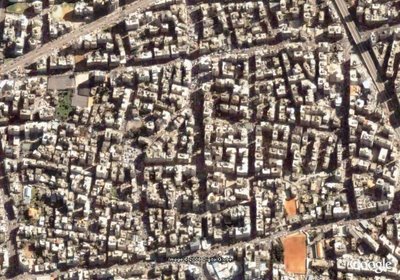
The Town that was Dahieh (South Beirut) before the bombings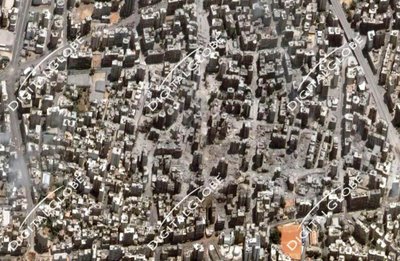
The Town that was Dahieh (South Beirut) after the bombings
This one is on a smaller scale than the first, hence you can see the roads.
Subscribe to:
Posts (Atom)